

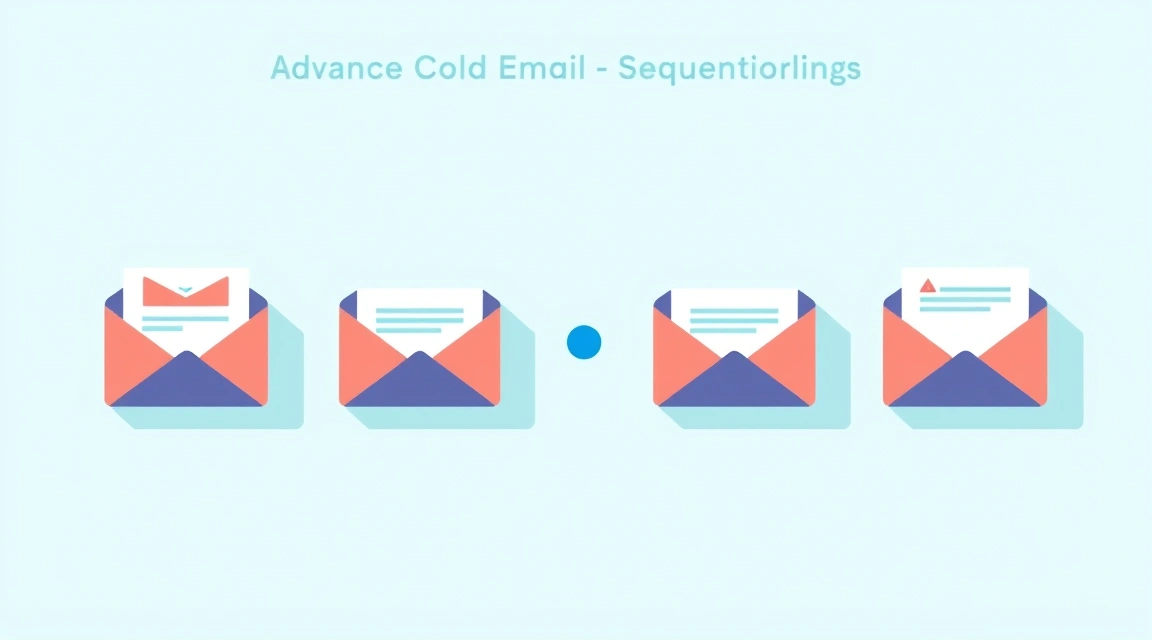
Advanced Cold Email Sequencing: Strategies for Higher Replies
To achieve higher reply rates in cold email outreach, advanced cold email sequencing involves strategically timed, multi-channel touchpoints, hyper-personalized messaging, and intelligent automation that nurtures prospects through a defined sales email cadence. This comprehensive guide will explore how to build these sophisticated sequences to significantly boost your engagement and conversion rates.
What Defines an Effective Cold Email Sequencing Strategy?
An effective cold email sequencing strategy extends far beyond sending a single, isolated email. It's a structured series of communications, carefully designed to engage, educate, and persuade a prospect over time. The goal is not just to elicit a response, but to build a connection and guide the prospect towards a desired action, whether that's a demo, a call, or a resource download. At its core, an advanced cold email sequence is characterized by:- Multi-touch approach: Acknowledging that one email is rarely enough.
- Strategic timing: Determining optimal delays between messages to avoid being pushy while staying top-of-mind.
- Varied content: Each email in the sequence offers a fresh perspective, additional value, or addresses a different pain point.
- Personalization at scale: Moving beyond basic merge tags to deliver truly relevant messages.
- Clear call-to-action (CTA): Guiding the prospect with a concise, low-friction next step.
Crafting Your Cold Email Follow Up Strategy: Timing and Cadence
The success of any cold email sequence hinges significantly on its timing and cadence. A well-thought-out cold email follow up strategy strikes a balance between persistence and respect, ensuring you stay visible without becoming a nuisance. Consider these benchmarks for an optimal sales email cadence:- Email 1 (Initial Outreach): Send on a Tuesday, Wednesday, or Thursday for best open rates.
- Email 2 (Value-add Follow-up): 2-3 days after Email 1. Reiterate your value proposition with a new angle or share a relevant resource (e.g., case study, blog post).
- Email 3 (Problem/Solution Focus): 4-5 days after Email 2. Address a specific pain point and offer your solution as a direct remedy.
- Email 4 (Social Proof/Urgency): 3-4 days after Email 3. Introduce social proof (testimonials, awards) or create a gentle sense of urgency.
- Email 5 (Breakup Email): 5-7 days after Email 4. This is often the final email, politely stating you'll stop outreach but offering one last chance to connect. This can often yield a surprising number of replies from prospects who were simply busy.
Personalization at Scale: Beyond First Name
True personalization goes beyond merely inserting a prospect's first name and company. Advanced cold email sequencing demands deeper relevance that speaks directly to the individual's role, industry, challenges, and even recent activities. Strategies for impactful personalization include:- Leverage Public Data: Use LinkedIn, company websites, news articles, and industry reports to understand their business goals, recent achievements, or specific challenges. Mentioning a recent funding round, a new product launch, or a shared connection can instantly grab attention.
- Identify Their Tech Stack: Tools like BuiltWith or similar services can reveal technologies a company uses, allowing you to tailor your pitch to integrate with or replace existing solutions.
- Reference Shared Experiences: Did you attend the same webinar? Are you part of the same professional group? A subtle reference can build instant rapport.
- Dynamic Content Snippets: Utilize your cold email automation platform to insert custom fields based on prospect segments. For example, if you're targeting marketing managers, a snippet might reference "driving qualified leads," while for a sales manager, it might be "shortening sales cycles."
Need to validate your email list before sending?
Postigo offers free email validation, MX checking, and deliverability tools — no signup required.
Try Free Tools →Integrating Multi-Channel Outreach Strategy for Maximum Impact
In today's crowded digital landscape, relying solely on email for your cold outreach sequence can limit your potential. A robust multi-channel outreach strategy integrates various communication touchpoints to increase visibility and engagement. Here’s how to effectively weave multiple channels into your sequence:- Email First, then LinkedIn: After sending your initial email, wait 1-2 days. If no reply, send a LinkedIn connection request. In your request, mention you just sent an email and would like to connect professionally. This reinforces your message across platforms.
- Strategic Calling: After 2-3 emails and a LinkedIn touchpoint, a well-timed cold call can be highly effective. The prospect will have seen your name and company multiple times, making the call less "cold." Reference your previous email in your voicemail or during the conversation.
- Video Messaging: Tools like Loom or Vidyard allow you to send short, personalized video messages. This can be a powerful follow-up after a few emails, demonstrating a higher level of effort and personal touch.
- Retargeting Ads: For high-value prospects, consider running targeted ads on LinkedIn or other platforms that reinforce your message or offer, ensuring your brand stays top-of-mind.
- Day 1: Cold Email 1 (Introduction)
- Day 3: LinkedIn Connection Request (Reference Email 1)
- Day 5: Cold Email 2 (Value-add follow-up)
- Day 8: LinkedIn Message (If connected, brief follow-up)
- Day 10: Cold Email 3 (Case Study/Social Proof)
- Day 12: Cold Call (Reference previous emails/LinkedIn)
- Day 15: Cold Email 4 (Breakup or final value proposition)
Leveraging Cold Email Automation for Efficiency and Scalability
Manual cold outreach is time-consuming and prone to errors. Cold email automation platforms are indispensable for implementing advanced cold email sequencing strategies, allowing you to scale your efforts without compromising personalization. Platforms like Postigo.net provide the tools to:- Schedule and Automate Follow-ups: Set up predefined delays and triggers for subsequent emails in a sequence. If a prospect replies, the sequence can automatically stop, preventing irrelevant follow-ups.
- Personalize at Scale: Use custom fields and dynamic content to personalize email templates for thousands of prospects simultaneously.
- A/B Test Elements: Experiment with different subject lines, body copy, CTAs, and even timing to continuously optimize your sequence's performance.
- Track Performance: Monitor open rates, click-through rates, and reply rates for each email in your sequence, identifying what works and what doesn't.
- Manage Deliverability: Ensure your emails reach the inbox by integrating with tools for email validation, checking SPF records, and monitoring blacklist checks to maintain a healthy sender reputation and avoid email bounce issues.
Essential Cold Email Sequence Elements and Templates
Every email in your sequence serves a distinct purpose. Here’s a breakdown of common elements and an example template:Email 1: The Introduction
- Subject Line: Intriguing, personalized, and benefit-oriented. (e.g., "Idea for [Company Name]", "Boosting [Metric] at [Company Name]")
- Opening: Show you've done your research. Briefly state why you're reaching out.
- Value Proposition: Clearly articulate the problem you solve and the benefit you offer.
- CTA: A low-friction ask (e.g., "Would you be open to a 15-minute chat?").
Email 2: The Value-Add Follow-up
- Subject Line: Reference previous email, add new value. (e.g., "Following up: Relevant resource for [Pain Point]", "Quick thought on [Industry Trend]")
- Content: Offer a relevant piece of content (blog, case study, video) that addresses a specific pain point.
- CTA: Still low-friction, perhaps asking for their thoughts on the resource or a brief discussion.
Email 3: The Problem/Solution Deep Dive
- Subject Line: Direct and problem-focused. (e.g., "Solving [Specific Problem] for [Industry]", "How [Your Solution] helps [Role]")
- Content: Reiterate a key challenge faced by prospects and present your solution as the answer. Use specific numbers or results if possible.
- CTA: A more direct ask for a demo or discovery call, but still respectful of their time.
Example Follow-up Email Template
Subject: Quick Follow-up: [Pain Point] Solution for [Prospect's Company]

Hi [First Name],

Hope you're having a productive week.

I recently reached out regarding [specific pain point or challenge] that many [Prospect's Industry] companies like [Prospect's Company] face, especially when it comes to [specific context].

We’ve helped companies like [Similar Company 1] and [Similar Company 2] overcome this by [briefly mention your solution's core benefit or unique selling proposition]. They saw a [specific metric, e.g., 25% increase in efficiency] and [another metric, e.g., 15% reduction in costs].

Would you be open to a brief 15-minute chat next week to explore how we could achieve similar results for [Prospect's Company]?

Best regards,

[Your Name]
[Your Title]
[Your Company]
[Your Website]
Comparing Advanced Cold Email Sequence Strategies
Different sequence types yield varying results depending on your target audience and objectives. Here's a comparison of common strategies:| Sequence Type | Description | Typical Length | Average Reply Rate | Key Benefit |
|---|---|---|---|---|
| Value-First Sequence | Focuses on providing free, relevant content or insights before a direct ask. | 3-5 emails | 8-12% | Builds trust, positions you as an expert, warms up prospects. |
| Problem/Solution Sequence | Identifies a common pain point specific to the prospect and directly offers your solution. | 4-6 emails | 7-10% | Direct relevance, addresses immediate needs, clear value proposition. |
| Multi-Channel Sequence | Integrates email with other touchpoints like LinkedIn messages, cold calls, or video. | 5-8 total touchpoints | 10-15% | Higher visibility, multi-pronged approach, caters to different preferences. |
| Breakup Sequence | A final email indicating you'll stop outreach, often prompting a last-chance reply. | 1 email (as part of a longer sequence) | 2-5% (of non-responders) | Creates urgency, clears inactive leads, often yields surprising replies. |
| Event-Triggered Sequence | Initiated by a specific event (e.g., prospect downloads a whitepaper, visits a specific page). | 3-4 emails | 12-18% | Highly relevant, capitalizes on existing interest, higher conversion potential. |
Key Recommendations for Higher Reply Rates
To continuously optimize your cold email sequencing and achieve higher reply rates, consider these recommendations:- Hyper-Personalize Every Touchpoint: Go beyond merge tags. Research each prospect to include unique, relevant details that show you understand their specific context and challenges.
- Vary Your Value Proposition: Each email in your sequence should offer a fresh angle or an additional piece of value. Don't just rephrase your initial message; build on it.
- Integrate Multi-Channel Touches: Combine email with LinkedIn messages, cold calls, and even personalized videos. A multi-pronged approach significantly increases your chances of connecting.
- A/B Test Constantly: Experiment with different subject lines, opening lines, body paragraphs, CTAs, and timing. Use data to refine your sequences and improve performance over time.
- Focus on Deliverability: Ensure your emails land in the inbox by regularly performing email validation, checking your MX records, and monitoring your sender reputation. Poor deliverability means your perfectly crafted sequence goes unseen.
- Keep CTAs Low-Friction: Ask for a small commitment initially, like a 15-minute chat or feedback on a resource, rather than a full demo immediately.
- Analyze and Adapt: Regularly review your sequence analytics. Identify drop-off points, emails with low engagement, and successful patterns. Be prepared to adjust your strategy based on these insights.
Key Takeaways
Mastering advanced cold email sequencing is crucial for boosting reply rates and driving conversions in modern outreach. By implementing strategic timing, leveraging deep personalization at scale, integrating a multi-channel approach, and utilizing robust cold email automation, businesses can build highly effective sales email cadences that consistently nurture prospects and generate significant results. Focus on providing continuous value and optimizing every step of your sequence for sustained success.Ready to launch your email campaign?
Start with 500 free emails. AI-powered personalization, SMTP rotation, and real-time analytics.
Start Free →Related Posts
Ready to scale your outreach?
Start sending personalized cold emails with AI-powered automation. Free trial, no credit card required.
Start Free Trial arrow_forward