

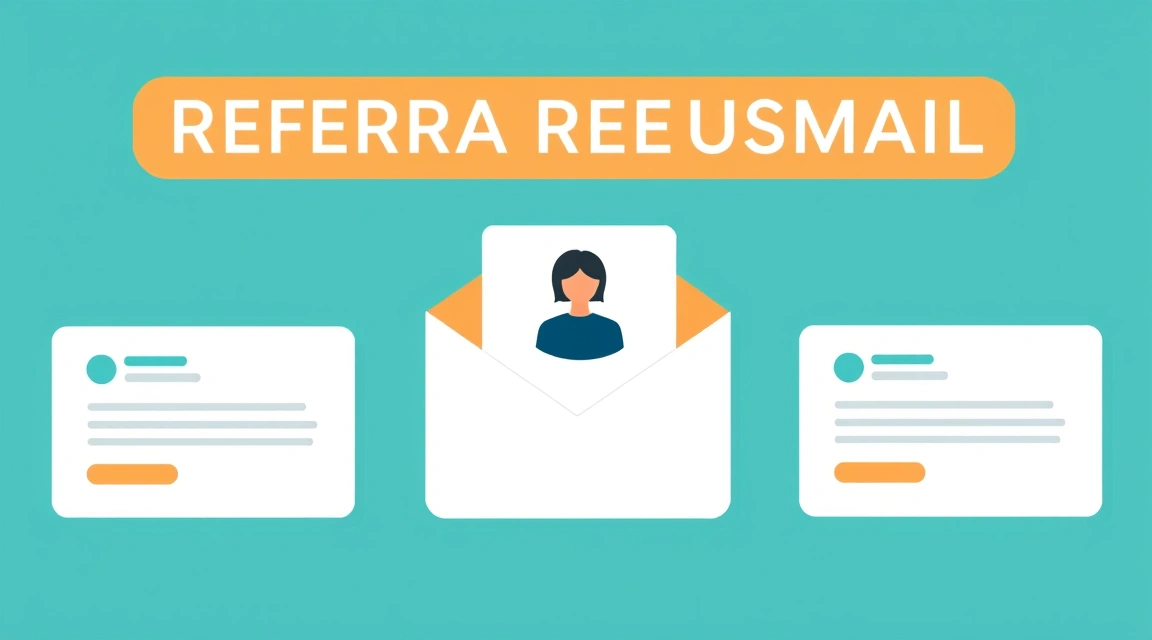
Referral Request Email: Templates for Getting Warm Introductions
Referral Request Email: Templates for Getting Warm Introductions
A well-crafted referral request email can be your most powerful tool for unlocking new opportunities and shortening sales cycles. Instead of a cold outreach to a complete stranger, a referral transforms it into a warm introduction, leveraging existing trust and relationships. In fact, personalized email subject lines alone can boost open rates by 50%, and when that personalization comes with a trusted referral, your chances of engagement skyrocket.
This article provides a comprehensive library of referral request email templates designed for various scenarios, from leveraging existing client relationships to making a strategic cold email referral request. We'll cover the psychology behind getting a "yes" and provide frameworks that make it incredibly easy for your contacts to introduce you. Each template includes a ready-to-copy email body with clear placeholders, a guide on when to use it, an explanation of why it works, and a specific A/B testing suggestion to optimize your results. Whether you're looking to ask for a referral email from a satisfied customer or craft a warm introduction email through a mutual connection, you'll find a strategy here to get introduced by email effectively.
Quick Reference Table: Referral Request Email Templates
Navigate our template library quickly to find the perfect referral outreach template for your needs.
| Template # | Type | Best For | Subject Line Preview |
|---|---|---|---|
| 1 | Warm Referral (Client) | Satisfied clients, post-success | Quick Question, {{FirstName}}? |
| 2 | Warm Referral (Mutual Connection) | Leveraging shared contacts | Referral via {{MutualConnection}} for {{ProspectCompany}} |
| 3 | Cold Referral (Value-First) | New contacts, offering immediate value | Idea for {{ProspectCompany}} (+ Referral?) |
| 4 | Cold Referral (Pain Point Focused) | Targeting common industry challenges | Solving {{PainPoint}} for {{Company}} - Any thoughts? |
| 5 | Specific Prospect Referral | Targeting a known individual | Introduction to {{ProspectName}} at {{ProspectCompany}}? |
| 6 | Post-Success Referral | After delivering exceptional results | Great results for {{Company}} - Who else needs this? |
| 7 | Consultative Referral | Seeking advice, opening door for referral | Seeking your expertise on {{IndustryTopic}} |
| 8 | "No Ask" Referral (Soft Approach) | Building goodwill, indirect referral | Resource for {{Industry}} professionals |
| 9 | Re-engage Past Contact | Reactivating dormant relationships | Checking in + a quick favor, {{FirstName}} |
| 10 | Referral Partner Request | Establishing formal referral relationships | Partnership opportunity: {{YourCompany}} & {{TheirCompany}} |
| 11 | Referral for Testimonial | Seeking feedback, leading to referral | Quick feedback on {{Product/Service}} |
| 12 | Follow-up Referral | Gentle reminder after initial request | Following up: Introduction to {{ProspectName}}? |
| 13 | Breakup Referral | Last attempt before disengaging | Closing the loop + a final ask |
| 14 | Specific Role Referral | Identifying the right contact in a company | Who handles {{SpecificRole}} at {{Company}}? |
| 15 | Referral with Incentive | Offering a reward for successful introductions | Quick intro + coffee on me? |
Referral Request Email Templates
Template 1: Warm Referral (Existing Client/Contact)
Subject: Quick Question, {{FirstName}}?
Hi {{FirstName}},

Hope you're having a productive week!

I was recently reflecting on the positive impact our work together had on {{SpecificProject/Goal}} at {{Company}}. It's been great seeing {{PositiveOutcome/Result}}.

I'm reaching out because I'm looking to connect with other {{Industry}} leaders who might be facing similar challenges with {{PainPoint}}. Do you know anyone in your network (perhaps at {{SimilarCompanyType}} or {{SpecificCompany}}) who could benefit from a conversation about how we helped {{Company}} achieve {{KeyBenefit}}?

No pressure at all, but any introductions would be greatly appreciated. Happy to draft a quick intro email for you to make it easy.

Best,

{{YourName}}
{{YourTitle}}
{{YourCompany}}
{{YourWebsite}}
When to Use: When you have a strong, positive relationship with an existing client or contact who has experienced success with your product or service.
Why It Works: It leverages your existing rapport and the recency of their positive experience. The offer to draft an intro email significantly reduces their effort, making it easier to say yes.
A/B Testing Suggestion: Test a more direct subject line like "Referral for {{Industry}} leaders" versus the softer "Quick Question, {{FirstName}}?".
Template 2: Warm Referral (Mutual Connection)
Subject: Referral via {{MutualConnection}} for {{ProspectCompany}}
Hi {{ProspectName}},

My name is {{YourName}} and I work at {{YourCompany}}. I'm reaching out to you today on the recommendation of {{MutualConnection}}, who suggested you might be the right person to speak with regarding {{SpecificTopic/Benefit}}.

{{MutualConnection}} mentioned that {{ProspectCompany}} is focused on {{ProspectCompanyGoal/Challenge}}, and given our success helping companies like {{SimilarCompany}} with {{SpecificBenefit}}, they felt there could be a valuable discussion.

Would you be open to a brief 15-minute chat sometime next week to explore how we've helped others achieve {{KeyResult}}?

Thanks,

{{YourName}}
{{YourTitle}}
{{YourCompany}}
{{YourWebsite}}
When to Use: When you have a shared contact who can provide a direct introduction to a specific prospect.
Why It Works: The mention of a mutual connection immediately establishes credibility and reduces the perceived "coldness" of the email. It also clearly states the value proposition relevant to the prospect's goals.
A/B Testing Suggestion: Experiment with explicitly stating the mutual connection's role in the recommendation versus a more subtle "suggested I reach out."
Template 3: Cold Referral Request (Value-First)
Subject: Idea for {{ProspectCompany}} (+ Referral?)
Hi {{FirstName}},

I noticed that {{ProspectCompany}} is {{RecentAchievement/FocusArea}} and it reminded me of a challenge we recently helped {{SimilarCompany}} overcome regarding {{SpecificPainPoint}}.

We developed a strategy that led to a {{QuantifiableResult, e.g., 25% increase in X}} for them. I have a few ideas on how this approach could potentially benefit {{ProspectCompany}} as well.

I'm not sure if you're the right person to discuss this with, but if you could point me to the individual who handles {{RelevantDepartment/Role}} at {{ProspectCompany}}, I'd be very grateful.

If not, no worries at all.

Best,

{{YourName}}
{{YourTitle}}
{{YourCompany}}
{{YourWebsite}}
When to Use: When reaching out to a contact without a prior relationship, but you have a strong value proposition that aligns with their company's potential needs.
Why It Works: It leads with value and a specific, proven result, making the request for a referral feel less intrusive. The "no worries if not" reduces pressure.
A/B Testing Suggestion: Try offering a specific resource (e.g., "I've attached a brief case study") instead of just "a few ideas" to enhance the value proposition.
Template 4: Cold Referral Request (Pain Point Focused)
Subject: Solving {{PainPoint}} for {{Company}} - Any thoughts?
Hi {{FirstName}},

I'm reaching out because I specialize in helping {{Industry}} companies like yours overcome {{SpecificPainPoint}}, which often leads to {{NegativeOutcome, e.g., wasted resources or missed opportunities}}.

We've developed a solution that has consistently helped our clients reduce {{PainPoint'sImpact}} by an average of {{Percentage, e.g., 30%}} and improve {{PositiveMetric}}.

I'm not sure if this is a challenge you're currently facing, or if you're the best person to address it. Could you perhaps point me in the direction of the individual at {{Company}} who is responsible for {{RelevantArea, e.g., sales efficiency or operational costs}}?

Thank you for your time.

Regards,

{{YourName}}
{{YourTitle}}
{{YourCompany}}
{{YourWebsite}}
When to Use: When you have identified a common pain point within a target industry or company, and you believe your solution directly addresses it.
Why It Works: It immediately frames the conversation around a recognizable problem and offers a proven solution, making the referral request feel like a helpful suggestion rather than a sales pitch.
A/B Testing Suggestion: Vary the subject line to include a specific benefit, e.g., "Boosting {{PositiveMetric}} for {{Company}}?".
Template 5: Specific Prospect Referral
Subject: Introduction to {{ProspectName}} at {{ProspectCompany}}?
Hi {{FirstName}},

Hope you're well!

I'm reaching out because I noticed you're connected with {{ProspectName}} at {{ProspectCompany}} on LinkedIn.

My team at {{YourCompany}} has been helping companies like {{SimilarCompanyA}} and {{SimilarCompanyB}} with {{SpecificBenefit/Challenge}}, and I believe we could offer significant value to {{ProspectCompany}} in their efforts around {{ProspectCompanyGoal}}.

Would you be comfortable making a brief introduction to {{ProspectName}}? I'd be happy to draft a short email for you to simplify the process.

Thanks so much for considering!

Best,

{{YourName}}
{{YourTitle}}
{{YourCompany}}
{{YourWebsite}}
When to Use: When you have a specific individual in mind at a target company and a mutual connection who can introduce you.
Why It Works: It's direct, concise, and provides clear context for the introduction. Offering to draft the email minimizes effort for the referrer, increasing the likelihood of a positive response.
A/B Testing Suggestion: Instead of "Introduction to...", try "Quick intro to {{ProspectName}}?" to convey brevity and ease.
Template 6: Post-Success Referral
Subject: Great results for {{Company}} - Who else needs this?
Hi {{FirstName}},

I'm still thrilled about the {{QuantifiableResult, e.g., 40% efficiency gain}} we achieved for {{Company}} with {{SpecificProject/Service}}! It was a pleasure working with you and seeing such a tangible impact.

As we continue to expand our reach, I'm eager to help more companies in {{Industry}} achieve similar results.

If you know any other {{JobTitle/Role}} in your network who might be grappling with {{SpecificPainPoint}} or looking to improve {{SpecificMetric}}, I'd be grateful for an introduction.

Feel free to forward my contact info, or if you prefer, I can send you a quick blurb to make an introduction easy.

Thanks again for your trust and partnership!

Best,

{{YourName}}
{{YourTitle}}
{{YourCompany}}
{{YourWebsite}}
When to Use: Immediately after a client has experienced significant, measurable success with your product or service. Their satisfaction is at its peak.
Why It Works: It capitalizes on the positive sentiment and recent success. The referrer is more likely to advocate for you when they've just seen the value firsthand.
A/B Testing Suggestion: Offer a small, non-monetary incentive for a successful introduction, such as "a complimentary {{Resource/Service}}" for them.
Template 7: Consultative Referral
Subject: Seeking your expertise on {{IndustryTopic}}
Hi {{FirstName}},

I truly value your insights and experience in the {{Industry}} space, especially regarding {{SpecificArea}}.

My team at {{YourCompany}} is currently exploring new strategies to help companies with {{CommonChallenge}}, and I was hoping you might be able to offer a quick perspective.

Do you know anyone in your network who is particularly focused on {{SpecificProblem}} or leading initiatives around {{RelatedSolution}}? I'd love to learn from their experience, and perhaps there's a way we could also provide value.

Any guidance or connections you could offer would be incredibly helpful.

Thanks in advance,

{{YourName}}
{{YourTitle}}
{{YourCompany}}
{{YourWebsite}}
When to Use: When you want to approach a potential referrer in a non-salesy way, by genuinely seeking their expert opinion or guidance, which can naturally lead to a referral.
Why It Works: It appeals to their ego and desire to be helpful. By asking for advice first, you lower their guard and open the door for a more natural referral conversation.
A/B Testing Suggestion: Instead of asking for a connection, try asking "Do you have 10 minutes next week to share your thoughts on X?" and then pivot to the referral during the call.
Template 8: "No Ask" Referral (Soft Approach)
Subject: Resource for {{Industry}} professionals
Hi {{FirstName}},

Hope you're doing well.

I was thinking of you because we recently published a new guide/report on "{{RelevantTopic for their Industry}}." It covers {{KeyInsight 1}} and {{KeyInsight 2}}, and I thought it might be valuable for you or someone in your network who's tackling {{SpecificChallenge}}.

You can find it here: {{LinkToResource}}

No need to reply, just wanted to share something I thought you'd appreciate.

Best,

{{YourName}}
{{YourTitle}}
{{YourCompany}}
{{YourWebsite}}
When to Use: To nurture a relationship or re-engage a contact without immediately asking for a favor. It builds goodwill and keeps you top-of-mind for future referral opportunities.
Why It Works: This approach is purely value-driven, with no immediate ask. It establishes you as a helpful resource and can prompt the recipient to think of others who might benefit, leading to an organic referral.
A/B Testing Suggestion: Follow up a few days later with a soft ask like, "Did you find the guide useful? Do you know anyone else who might benefit?"
Template 9: Re-engage Past Contact for Referral
Subject: Checking in + a quick favor, {{FirstName}}
Hi {{FirstName}},

It's been a while since we last connected, but I hope things are going great at {{Company}}!

I was thinking about our previous conversation around {{PastTopic}} and wanted to reach out.

My team at {{YourCompany}} is currently focusing on helping companies in {{Industry}} solve {{SpecificProblem}} more efficiently, leading to {{QuantifiableBenefit, e.g., 20% cost savings}}.

I'm wondering if you know anyone in your network who might be facing this challenge or looking for solutions in this area. I'd be grateful for any introductions you feel are appropriate.

Always great to hear from you.

Best,

{{YourName}}
{{YourTitle}}
{{YourCompany}}
{{YourWebsite}}
When to Use: To reactivate dormant relationships with past contacts who know you but haven't engaged recently.
Why It Works: It acknowledges the time gap, references a past connection, and then clearly states the value proposition before making a polite referral request. It feels less like a cold call and more like rekindling a relationship.
A/B Testing Suggestion: Include a personalized update about your company's recent achievements or a relevant industry trend before the ask.
Template 10: Referral Partner Request
Subject: Partnership opportunity: {{YourCompany}} & {{TheirCompany}}
Hi {{FirstName}},

I've been following {{TheirCompany}}'s work in {{SpecificArea}} and am particularly impressed with {{SpecificAchievement/Project}}.

At {{YourCompany}}, we specialize in {{YourCompany'sExpertise}}, and we've found that our clients often benefit from complementary services like those offered by {{TheirCompany}}.

I'm reaching out to explore the possibility of a mutual referral partnership. We often encounter clients who need {{TheirService}}, and I imagine you might come across those who could benefit from our {{YourService}}.

Would you be open to a brief call next week to discuss how we could potentially refer business to each other and create a win-win for our clients?

Looking forward to your thoughts.

Best,

{{YourName}}
{{YourTitle}}
{{YourCompany}}
{{YourWebsite}}
When to Use: When you want to establish a formal or informal referral partnership with another business that serves a similar audience but offers non-competing services.
Why It Works: It clearly outlines the mutual benefit of a partnership, emphasizing a win-win scenario. It focuses on how both companies can serve their clients better by collaborating.
A/B Testing Suggestion: Propose a specific, small-scale pilot project or joint webinar idea instead of just a general discussion about partnership.
Template 11: Referral for Testimonial (Leading to Referral)
Subject: Quick feedback on {{Product/Service}}
Hi {{FirstName}},

Hope you're doing great!

I'm reaching out because we're collecting feedback on our {{Product/Service}} to ensure we're continuously improving. Your insights are incredibly valuable to us.

Would you be open to sharing a quick testimonial about your experience, specifically regarding how {{Product/Service}} helped you achieve {{SpecificBenefit}}?

Also, as we grow, we're always looking to help more companies like yours. If you know anyone in your network who could benefit from {{YourSolution}}, I'd be grateful for an introduction. No pressure at all, of course.

Thanks for your continued support!

Best,

{{YourName}}
{{YourTitle}}
{{YourCompany}}
{{YourWebsite}}
When to Use: After a client has had a positive experience and you're seeking a testimonial, which can naturally open the door for a referral request.
Why It Works: It combines two asks (testimonial and referral) in a way that feels natural. The testimonial request reinforces their positive experience, making them more likely to refer you.
A/B Testing Suggestion: Separate the testimonial request and the referral request into two distinct emails, sent a few days apart, to see if it increases response rates for both.
Template 12: Follow-up Referral Request
Subject: Following up: Introduction to {{ProspectName}}?
Hi {{FirstName}},

Just circling back on my previous email regarding a potential introduction to {{ProspectName}} at {{ProspectCompany}}.

I understand you're busy, so no worries if this isn't a good time. However, I truly believe a connection could be beneficial for {{ProspectCompany}} given their focus on {{CompanyGoal}} and our success with {{SimilarCompany}}.

If you're able to help, I've attached a very brief intro message you can simply copy and paste.

Thanks again for your consideration!

Best,

{{YourName}}
{{YourTitle}}
{{YourCompany}}
{{YourWebsite}}
When to Use: As a gentle nudge when your initial referral request hasn't received a response after 3-5 business days.
Why It Works: It's polite, brief, and reiterates the value proposition without being pushy. Providing a pre-written intro message removes any remaining friction for the referrer.
A/B Testing Suggestion: Try a follow-up that offers a new piece of valuable content (e.g., "Thought this article on X might be relevant, and it relates to why I asked about {{ProspectName}}").
Template 13: Breakup Referral Request
Subject: Closing the loop + a final ask
Hi {{FirstName}},

It looks like now might not be the right time for us to connect regarding {{SpecificTopic}}, and I'll be closing our communication loop on this for now.

Before I go, I wanted to ask one last quick favor. My goal is to help more {{Industry}} companies like yours overcome {{CommonChallenge}}. If you happen to know anyone in your network who might be a good fit for a conversation about {{YourSolution}}, I'd be incredibly grateful for an introduction.

Even a quick name or email would be helpful.

Wishing you all the best.

Sincerely,

{{YourName}}
{{YourTitle}}
{{YourCompany}}
{{YourWebsite}}
When to Use: As a final attempt to get a referral after multiple outreach attempts have gone unanswered, or when you've decided to disengage from a prospect.
Why It Works: The "breakup" email often gets a response because it signals the end of the outreach, creating a sense of urgency or loss. It's a low-pressure ask that leverages the prospect's potential guilt or desire to be helpful.
A/B Testing Suggestion: Test a more direct breakup subject line like "Is this a goodbye?" followed by the referral ask.
Template 14: Specific Role Referral
Subject: Who handles {{SpecificRole}} at {{Company}}?
Hi {{FirstName}},

I hope this email finds you well.

I'm reaching out because I'm trying to connect with the person at {{Company}} who is responsible for {{SpecificRole or Department, e.g., "marketing automation" or "supply chain logistics"}}.

Our company, {{YourCompany}}, helps businesses like yours achieve {{KeyBenefit, e.g., "a 15% reduction in operational costs"}} by {{HowYouDoIt}}. I believe there could be significant value in a conversation for the person overseeing {{SpecificRole}}.

Would you be able to point me in the right direction or suggest who might be the best contact? Any help would be greatly appreciated.

Thanks,

{{YourName}}
{{YourTitle}}
{{YourCompany}}
{{YourWebsite}}
When to Use: When you know the specific function or role you need to reach within a company, but you don't have a direct name or connection.
Why It Works: It's a very clear, low-friction request. You're not asking for a meeting, just for information, which is easier for someone to provide. It also states the value proposition upfront.
A/B Testing Suggestion: Instead of "Who handles...", try "Quick question about {{SpecificRole}} at {{Company}}?" to create more curiosity.
Template 15: Referral with Incentive
Subject: Quick intro + coffee on me?
Hi {{FirstName}},

Hope you're having a good week!

I'm reaching out because I'm expanding my network in the {{Industry}} sector, specifically looking to connect with {{TargetPersona, e.g., "CTOs focused on cloud migration"}} who might be interested in {{YourSolution}}.

If you know someone in your network who fits this description and you're willing to make a brief introduction, I'd love to treat you to a virtual coffee (or a {{SmallGiftCard, e.g., $25 Amazon gift card}}) as a thank you for your time and help.

I'm happy to draft a quick intro message to make it super easy for you.

Let me know if you can think of anyone.

Best,

{{YourName}}
{{YourTitle}}
{{YourCompany}}
{{YourWebsite}}
When to Use: When you want to provide an extra motivator for contacts to refer you, especially if you're asking for a referral from someone who might not be a direct client.
Why It Works: Reciprocity is a powerful psychological trigger. A small, thoughtful incentive can significantly increase the likelihood of someone taking the time to make an introduction.
A/B Testing Suggestion: Test a non-monetary incentive, such as "a complimentary audit of their {{RelevantArea}}" or "exclusive access to our premium resource."
Personalization Tips for High-Impact Referrals
Beyond simply filling in `{{FirstName}}` and `{{Company}}`, true personalization is what transforms a generic template into a compelling referral request email. Here's how to customize your outreach for maximum impact:
- Reference Specific Data Points: Mention recent news about their company (e.g., a new product launch, funding round, expansion), a shared industry event you both attended, or a mutual connection's recent achievement. This shows you've done your homework.
- Leverage Triggers: What specific actions or changes might indicate a need for your service? A recent hire in a relevant department, a public announcement of a strategic shift, or even a competitor's recent success can be a trigger to mention.
- Timing is Everything: Send your referral request when it's most relevant. For clients, this is often immediately after a successful project or renewal. For prospects, it could be after a relevant industry report is released or a major conference concludes.
- Show, Don't Just Tell: Instead of saying "we help companies save money," specify "we helped Company X reduce their {{specific cost}} by 30% in 6 months." Quantifiable results make your value tangible.
- Personalize the Ask: Tailor the type of referral you're seeking. Instead of a general "do you know anyone?", ask "do you know anyone at {{SpecificCompany}} who might be struggling with {{SpecificPainPoint}}?"
- Validate Email Addresses: Before sending out highly personalized referral requests, especially for cold outreach or re-engaging old contacts, ensure your emails will actually reach the inbox. Use an email validation tool to verify addresses and check for potential issues like bounces. This also applies to ensuring your own email sending infrastructure is healthy; regularly check your MX records and SPF records to maintain high deliverability and avoid email bounces.
- Consider the Channel: While email is primary, a quick LinkedIn message or even a phone call after a positive interaction can set the stage for an email referral request.
Key Takeaways
Getting a warm introduction is significantly more effective than cold outreach, often resulting in 4x higher conversion rates compared to traditional cold calls. The templates provided here offer a robust foundation for your referral strategy, but their true power lies in thoughtful personalization and a clear understanding of human psychology.
For warm contacts and existing clients, focus on leveraging shared success and making the ask incredibly easy (Templates 1, 6, 11). When reaching out to colder contacts, lead with undeniable value or a clear solution to a pain point before requesting an introduction (Templates 3, 4, 8). Always aim to reduce friction for the referrer, articulate the benefit for the referred, and maintain impeccable email hygiene to ensure your messages land where they should.
Need to validate your email list before sending?
Postigo offers free email validation, MX checking, and deliverability tools — no signup required.
Try Free Tools →Ready to launch your email campaign?
Start with 500 free emails. AI-powered personalization, SMTP rotation, and real-time analytics.
Start Free →Related Posts
Ready to scale your outreach?
Start sending personalized cold emails with AI-powered automation. Free trial, no credit card required.
Start Free Trial arrow_forward