

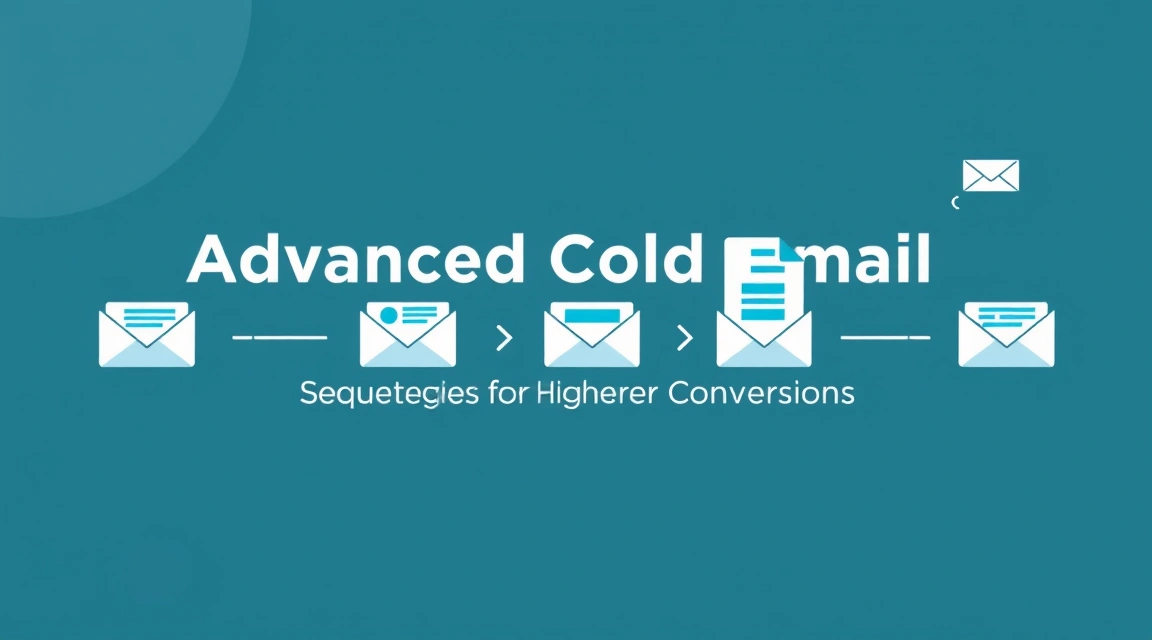
Advanced Cold Email Sequencing: Strategies for Higher Conversions
What is a Cold Email Sequence and Why Does it Matter for Conversions?
A cold email sequence is a pre-defined series of emails sent to a prospect who has not previously interacted with your brand. Unlike a single cold email, a sequence is a systematic approach, typically comprising 3-7 emails, each with a specific goal and delivered over a set period. This multi-step cold email approach acknowledges that a single touchpoint is rarely enough to capture attention, build trust, or prompt action in today's crowded inboxes.
The primary advantage of an effective email sequence strategy is persistence with value. Prospects are busy, and your initial email might be missed, forgotten, or simply arrive at an inconvenient time. A well-designed sequence provides multiple opportunities to engage, offering varied angles, additional value, and gentle reminders without being intrusive. This systematic nurturing significantly boosts the likelihood of a positive response, with studies showing that follow-up emails can increase reply rates by up to 22% compared to standalone emails. For businesses aiming for higher conversions, moving beyond one-off messages to a structured cold outreach sequence is not just an option, but a necessity.
Crafting Your Cold Email Sequence Strategy for Success
Building an effective cold email sequence strategy begins with a deep understanding of your target audience and a clear definition of your objectives. Without these foundational elements, even the most sophisticated automation tools will yield subpar results.
Understanding Your Audience and Goal
Before writing a single word, identify your Ideal Customer Profile (ICP). What are their pain points? What are their aspirations? What industry trends affect them? This insight allows for hyper-personalization, making your emails resonate more deeply. Your goal for the sequence should also be precise: Is it to book a demo? Schedule a call? Drive a trial signup? Obtain a referral? Each goal dictates the content and call-to-action (CTA) of your emails.
Mapping the Multi-Step Cold Email Journey
A typical multi-step cold email journey progresses through several phases, each with a distinct purpose:
- Introduction & Problem Identification: The first email aims to introduce yourself, state the prospect's likely problem, and hint at a solution. Keep it concise and focused on them.
- Value Proposition & Social Proof: Subsequent emails expand on the solution, introduce specific benefits, and offer evidence like case studies, testimonials, or relevant statistics.
- Objection Handling & Use Cases: Address common objections or provide specific examples of how your solution has helped similar businesses.
- Gentle Nudges & Resource Sharing: Offer valuable content (blog posts, guides, webinars) that educates and builds credibility without directly selling.
- Breakup Email: The final email in a sequence, signaling that you'll stop reaching out, often prompts a response from prospects who were on the fence.
Each step should build upon the last, adding value and progressing the prospect closer to your desired action. Avoid repetition; instead, offer new insights or perspectives.
Need to validate your email list before sending?
Postigo offers free email validation, MX checking, and deliverability tools — no signup required.
Try Free Tools →Content Variations for Each Step in Your Sales Email Sequence
The success of a sales email sequence hinges on varied, valuable content that maintains engagement without feeling repetitive. Here are examples for different steps:
Email 1: The Opener – Personalization & Problem Focus
This email needs to immediately grab attention and demonstrate relevance.
Subject: Quick question about [Prospect's Company Goal/Challenge]

Hi [Prospect Name],

My name is [Your Name] from Postigo.net. I noticed [Specific observation about their company/industry/role, e.g., "you're focused on scaling your outbound sales efforts" or "your team recently launched X product"].

Many [Your ICP] struggle with [Pain Point, e.g., "low cold email reply rates" or "managing complex multi-step outreach manually"]. We help companies like yours [Briefly state your solution's core benefit, e.g., "streamline their cold outreach and boost conversions by up to 30%"].

Would you be open to a brief 10-minute chat next week to see if we can help?

Best,
[Your Name]
[Your Title]
[Your Company]
Email 2: Value Proposition & Social Proof
Following up, this email provides more concrete evidence of your value.
Subject: Re: Quick question about [Prospect's Company Goal/Challenge] - How [Benefit]

Hi [Prospect Name],

Just following up on my previous email. I thought it might be helpful to share how [Specific Company Type, e.g., "SaaS companies with 50-200 employees"] are using Postigo.net to [Achieve specific result, e.g., "automate their cold email sequences and see a 2x increase in qualified leads"].

For example, [Client Name/Type of Client] increased their meeting booked rate by 25% within the first month using our platform's advanced sequencing features and email validation tools.

Are you facing similar challenges with [Pain Point]? Perhaps we could connect for a quick call to discuss your current approach.

Regards,
[Your Name]
Email 3: The Gentle Nudge & Objection Handling
This email anticipates common hesitations or offers more direct value.
Subject: Thought you might find this useful: [Relevant Resource Title]

Hi [Prospect Name],

Hope you're having a productive week.

I understand you're likely busy, but I wanted to share a quick resource that might be relevant to your work on [Their Focus Area]. This [Blog Post/Case Study/Webinar] on [Topic] addresses [Specific challenge] and outlines strategies to [Desired outcome].

[Link to Resource]

We've found that many prospects wonder about [Common Objection, e.g., "the time commitment for setup"]. Our platform is designed for quick integration, with most users launching their first SMTP-powered cold email sequence within an hour.

Let me know if you have any questions after reviewing it.

Thanks,
[Your Name]
Email 4+: Breakup & Re-engagement
The final email often prompts a response from those who were silently considering.
Subject: Closing the loop on [Topic]

Hi [Prospect Name],

This will be my last email regarding [Topic/Our Service]. I haven't heard back, which tells me one of a few things:
1. This isn't a priority for you right now.
2. You've already found a solution.
3. My timing is off.
4. My emails are just ending up in your spam folder (you can check your domain's blacklist status here if you're curious!).

No worries at all. If anything changes or you want to revisit [Your Solution] in the future, please don't hesitate to reach out.

Wishing you success with [Prospect's Company Goal].

Best,
[Your Name]
Optimal Timing and Cadence for Cold Outreach Sequence Success
The effectiveness of a cold outreach sequence isn't just about what you say, but also when and how often you say it. Optimal timing and cadence are crucial for maintaining engagement without causing fatigue or annoyance.
Timing between emails: The ideal delay between emails can vary by industry, but common best practices suggest increasing intervals:
- Email 1 to Email 2: 2-3 business days. This is a quick follow-up to catch those who missed the first.
- Email 2 to Email 3: 3-5 business days. Allows more time for consideration and avoids feeling pushy.
- Email 3 to Email 4: 5-7 business days. Longer gaps are good for providing value without expecting an immediate response.
- Subsequent Emails: 7+ business days. These can be more spaced out, perhaps offering new resources or a final "breakup" email.
Day of the week: Data suggests that Tuesdays, Wednesdays, and Thursdays often yield the highest open and reply rates. Mondays are typically busy with internal meetings, and Fridays can see reduced engagement as people wind down for the weekend. However, always test this for your specific audience.
Time of day: Early mornings (8-10 AM) and mid-afternoons (1-3 PM) are generally good windows. Avoid sending during lunch hours or late evenings when prospects are less likely to be actively checking work emails.
Sequence Length: While there's no magic number, 4-7 emails is a common range for a comprehensive cold email sequence. Going beyond 7 emails without a response can often lead to diminishing returns and potential negative sentiment. Remember, quality over quantity.
Leveraging Cold Email Automation for Maximum Impact
Manually managing a multi-step cold email sequence for hundreds or thousands of prospects is impractical and prone to errors. This is where cold email automation platforms like Postigo.net become indispensable. Automation allows you to:
- Schedule and Deliver: Automatically send emails at pre-defined intervals, ensuring consistent cadence.
- Personalize at Scale: Use custom fields (e.g.,
{{prospect_name}},{{company_name}}) to personalize each email dynamically, making mass outreach feel one-to-one. - Track Performance: Monitor open rates, click-through rates, reply rates, and bounce rates for each email in your sequence. This data is critical for A/B testing and optimization.
- Automate Follow-ups: Set rules to automatically send the next email in the sequence if a prospect doesn't reply, or pause the sequence if they do.
- A/B Test Elements: Experiment with different subject lines, body copy, CTAs, and timing to identify what resonates best with your audience.
- Integrate with CRM: Seamlessly log activities and update prospect statuses in your Customer Relationship Management (CRM) system.
Effective automation frees up your sales team to focus on engaging with interested prospects rather than administrative tasks. For robust deliverability, ensure your SMTP settings are correctly configured and you're using dedicated IPs where appropriate. Regular MX record checks and SPF checks are also vital for maintaining sender reputation.
Essential Best Practices for Higher Conversions
To truly master advanced cold email sequence strategies and achieve higher conversions, incorporate these critical best practices:
- Hyper-Personalization: Go beyond just name and company. Reference specific achievements, recent news, or shared connections. Tools like Postigo's email extractor can help gather data, but human touch is key for quality personalization.
- Compelling Subject Lines: Craft subject lines that are short, clear, and spark curiosity. A/B test different approaches (e.g., question-based, benefit-driven, ultra-short) to see what resonates. Aim for 4-7 words.
- Clear Call-to-Action (CTA): Each email should have one, unambiguous CTA. Make it easy for the prospect to take the next step. "Are you free for a 15-minute chat next Tuesday?" is better than "Let me know if you're interested."
- Value-First Approach: Focus on solving the prospect's problems, not selling your product. Position your solution as a means to achieve their goals.
- Mobile Optimization: A significant percentage of emails are opened on mobile devices. Ensure your emails are concise, easy to read, and links are tappable.
- Deliverability Management: Regularly validate email addresses to minimize bounces, which can damage your sender reputation and lead to SMTP error 550 issues. Monitor your domain's health and avoid hitting Gmail sending limits or other provider limits.
- A/B Testing Continuously: Test every element: subject lines, opening lines, body paragraphs, CTAs, email length, and even timing. Small improvements can lead to significant gains in conversion rates.
- Integrate Multi-Channel Touchpoints: While not strictly email, consider integrating other channels into your overall cold outreach sequence, such as LinkedIn messages or even a cold call, for truly advanced strategies.
Common Cold Email Sequence Models & Their Focus
| Sequence Model | Primary Focus | Typical Length (Emails) | Key Conversion Metric |
|---|---|---|---|
| AIDA (Attention, Interest, Desire, Action) | Guiding prospect through psychological stages to conversion. | 4-6 | Reply Rate, Meeting Booked |
| PAS (Problem, Agitate, Solution) | Highlighting pain, amplifying it, then offering a fix. | 3-5 | Engagement, Demo Request |
| Value-First | Providing direct value (content, insights) before a soft ask. | 5-7 | Content Clicks, Reply Rate |
| Direct Ask | Concise and to-the-point with a clear CTA early on. | 2-4 (with quick follow-ups) | Meeting Booked, Trial Signup |
| Testimonial/Social Proof | Leveraging success stories and client endorsements. | 3-5 | Trust Building, Referral |
Key Takeaways
Mastering advanced cold email sequencing is about strategic, personalized, and persistent communication. By implementing a multi-step approach, varying content, optimizing timing, and leveraging cold email automation, businesses can significantly elevate their conversion rates and build stronger pipelines. Remember to continuously test and refine your sequences for optimal performance.
Ready to launch your email campaign?
Start with 500 free emails. AI-powered personalization, SMTP rotation, and real-time analytics.
Start Free →Related Posts
Ready to scale your outreach?
Start sending personalized cold emails with AI-powered automation. Free trial, no credit card required.
Start Free Trial arrow_forward